Monday, July 14, 2014

Three Important Bloggers in Adult Ed.

On Twitter, I can just retweet the latest from adult education's brightest thought leaders and come off looking smart and well read.  But on my blog, I've got to quote people or just steal their ideas outright (kidding!). Here are a few folks that I come back to regularly, either reading or retweeting or both. You should make them regular stops or bookmarks, if you haven't already.


David Rosen has long been a resource for adult education strategic thinking.  His most recent blog goes over ten technology trends that stand to transform adult education in the US.   Rosen's focus on innovation and equity make him a gem in the field, in my estimation.


Meagan Farrell's has been sharing free GED prep resources on her Farrell Ink site for years, and now you can find some highlights of her professional development workshops here. This week, she's going to post five times while at a conference in Virginia.  By the way, it looks like Essential Education will be directly benefiting from Meagan's instructional strategies as she helps us develop new online and print material.

Jeff Carter writes about adult education policy, budget ramification, and there's a helpful survey of adult education's occasional appearances in the media.  He's got his own angle, and he moves the conversation forward, something we should all be doing.  I'm especially glad for his unpacking of the WIA reauthorization, aka WIOA.

Wednesday, July 2, 2014

5 Predictions for Adult Education Instruction

So far this year, I'm seeing adult education programs implementing a variety of approaches as they tackle the 2014 high school equivalency exams.  The range of hypotheses that teachers and publishers are employing is pretty impressive, though sometimes disconcerting. Nonetheless, a diversity of tactics is good.  Hypotheses, if evaluated critically, will be proven right or wrong, and adult education practice will move forward all the better for having conducted experiments during this big transition.  I've got some hypotheses that I don't mind sharing.  Some directly oppose other publishers' products and even some of my own clients' preferred teaching methods.  That's the thing about the future. It's not personal.     

Increased Experimentation and Creative Lesson Design
Most adult ed programs have begun the year trying to maintain their systems of assessment, instruction and credentialing and ensure continuity by continuing with drill and practice material, teaching narrowly to a small set of procedural knowledge skills that are typically deficits.  To stay in that comfort zone, adult ed programs purchase from publishers that are recycling instructional models or repackaging conveniently available material with 2014 testing jargon that are familiar and friendly to adult educators who are struggling with the prospect of change (very common and understandable).  However, as the demands of the new high school equivalency tests and the College and Career Readiness standards become clearer and professional development efforts start to sink in with instructors and coordinators, the field will start taking more risks.  They'll start thinking outside the box with their lesson planning and where they source their content. 

Monday, June 30, 2014

Dad, My First Technology Teacher

My dad was a geek.  It wasn't until recently that I realized all that he did for me in terms of technology skills, but since his passing in March, it's all starting to come back to me.  In the early 80s, he got me using a Commodore 64. Eventually, we were using an IBM compatible desktop 486 from Leading Edge, while my mother still swore by her 75lb IBM Selectric typewriter (both relevant and marketable skills, depending on the context).  He helped me understand floppy discs and how to install and run computer games.  But, by the time I got my first Nintendo, our technology interests seemed to part ways, as more and more products were designed to speak to my age-range specifically.  Meanwhile, my dad climbed the ranks of the science world from 9-5 and on numerous trips around the country/world. 

After my dad passed away in March, my mother and I went to work on his obituary.  The man was so accomplished in his professional life, we really tried to get a lot of it into one story that we hoped would be published by the Washington Post. You'll see in the story obituary below that my father had a lot more to offer than simply upgrading to the latest computer as they came out.  I didn't go into any of the STEM career fields, and he didn't pressure me at all.  It was my belief in social justice that really made him proud seeing his legacy continue.  I hope that my work in the field of adult education will build on his focus on innovation in the public interest with a keen emphasis on equity.

Thanks for everything, Dad. 

Harold E. ("Hal") Guard, Ph.D. retired award-winning scientist with the Office of Naval Research (ONR) for achievements in environmental programs, equal opportunities for minorities and women; and with Historically Black Colleges and Universities, died March 16, 2014, at Carlton Plaza Assisted Living in San Leandro, CA, after several years living with Early Onset Alzheimer's Disease.

Friday, April 11, 2014

Get Your FREE Extended Response Writing Workbook

This year's COABE conference was a big success for Essential Education.  But, personally, it was a tough road to hoe for me.  As I drove into Pittsburgh, I got the news from my step-brother that our father had just passed away.  It wasn't sudden, but it was terrible timing (as if there is a good time to lose a parent). I decided on my own that 'the show must go on,' and I followed through with my duties at our exhibit and gave my presentations on disruptive innovations and the digital classroom.  But, I was a hollow shell of myself. If you met me at COABE, this is why I wasn't more gregarious.

Luckily, I didn't need to be a carnival barker to bring people to the table. They were beating a path straight to us so they could take home a free copy of our Extended Response writing workbook.  It's going to be a huge help to instructors looking for ways to teach writing skills beyond the old 5-paragraph essay model.  And after helping people search their souls for personal stories to tell, we have a big adjustment to make in focusing on evidence-based argumentation.  This book will help with that.  Did you miss us at COABE or did you miss the conference altogether?

Get Your FREE Workbook RIGHT HERE 

Essential Education probably gave away 600-700 copies of this 128 page workbook at COABE. The previous year, we gave away 800 copies of our 2014 GED Test Curriculum Blueprint.  We're really trying to help adult educators look at the biggest changes that impact their crucial roles of facilitating and mentoring and teaching.  The freebees are just the tip of the iceberg of all that we've got to offer.   We launched updates to GED Academy as well as new versions: TASC Acacemy and HiSET Academy.  And our workbooks apply to all three high school equivalency exams.

I don't know about the lasting value of the tote bags and other swag that is always given out at conferences. There are lots of ways to build a brand. Essential Education aims to build affinity with our fellow educators and earn your respect by providing the best possible resources.  On a less serious note, one of you COABE attendees was giving away a nasty flu or virus type sickness, because I brought it home and spent the next several days with a high fever, and each of my three small children and my wife all had a bout of that cold as I started to get better.  Definitely a conference to remember for me, albeit a little hazy. Looking forward to Denver in 2015.    

Saturday, March 8, 2014

Follow the Yellow Brick Road to COABE 2014

Why? Because because because because the wonderful things COABE does. We're off to see the Wizard... the wonderful Wizard of... adult education.  Well, that's pretty much how I've felt about it since the first time I went almost ten years ago.  Each COABE conference fueled my imagination of what is possible in adult education for the coming year or longer (since I haven't gone consistently).  My daily experience in adult ed, no matter how trying or frustrating, comes into focus much more easily having benefited from the perspectives of adult educators like me from all over the country. The wizard, you see, is not a fraud hiding behind a curtain. The wizard is us.  And when we come together, there is a lot of heart, brains, and courage to go 'round. 

For a lot of people, there are some detours in the yellow brick road to COABE this year. The field of adult education is under construction. There's no mistaking it. Traffic cones are up everywhere. Signs to slow down or merge together.  Maybe some flying monkeys and poppies that put you to sleep too.  For a field that changes at a glacial pace, the tectonic plates are moving beneath our feet suddenly and unpredictably.  We're not in Kansas anymore. How will we find our way home?

Although the changes largely concern high school equivalency, the impacts reach down to the lower levels and spread out to incorporate technology and media literacy among other learning and thinking styles.  If this year is going to be a grand experiment, it may not be the learners who are the main subjects. Teachers' skills and managers' ability to adapt are being tested in a more rigorous way than any high school equivalency test could ever challenge our learners.

I think publishers of instructional materials are being tested too.  Some are turning in the same drill and practice product that's light on instruction and acting as though it will be sufficient. That's why I'm so excited to be at COABE to help educators chart a new direction, avoid wasting time and money, and help their learners reach higher expectations.  Tests that assess something different than we're used to require material with a different focus and probably different instructional methodologies.  That's a challenge that Essential Education is ready for.

At COABE, I hope you'll find time to visit our exhibit and attend one of the sessions (see below).  I'll be there, because my wife isn't having a baby during the conference like last year.  I'll be giving our evidence-based extended response writing mini-book (email me for an electronic copy: jason at essentialed.com).  If you see me there, let me know that you saw this blog. Looking forward to it!    

Sunday, March 2, 2014

Technology Boogieman Actually Your New BFF

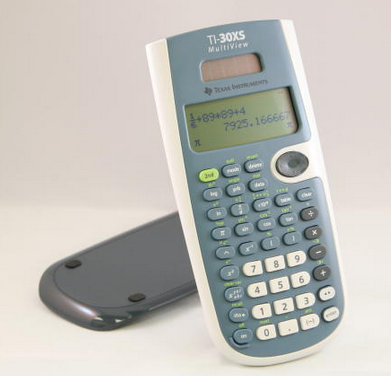
Even though I've been a big proponent of computer-based testing, I have to confess that the TI-30xs calculator scares the crap out of me.  There are so many buttons, and more than half of them are foreign to me, and even those buttons have secondary functions represented by  hieroglyphs in tasteful chartreuse (my wife's favorite color).  People ask me about the new calculator and I explain that it's just like old Casio GED calculator: you actually teach how to ignore all the buttons that you'll never use.  Sometimes I'll joke that the TI-30xs name is appropriate, because it's XS-ive.   These were the rationalizations I've clung to while avoiding this and other scientific calculators.  But then, just this past week, I saw the light.


There was a similar freak-out about the introduction of the Casio FX-260 in 2002.  That piece of mandatory technology inspired a kind of mass-anxiety among adult educators similar to the one we've been dealing with as the test has gone computer-based.  During those 12 years, I was big on web-based distance learning, but I coped with the calculator by avoiding all but the most basic buttons.  The funny joke picture here about the 'C' and 'CE' buttons... that's totally me.  I even came across a TI-30xs at a yard sale, got it for 10 cents, and I've been weary and suspicious and hesitant to use it ever since.  Kind of like with the Coke bottle in The Gods Must Be Crazy, I'd probably be more likely to hit someone over the head with that calculator than to solve a complex math problem with it.   In the movie, they worshiped that Coke bottle briefly too, right? So maybe there are multiple ways to relate to a device that seems to come from another dimension.


Thursday, December 19, 2013

Computer-Based Testing/Learning Strategies

Recently, a pithy post in Fast Company magazine garnered some good press for the GED Testing Service's computer-based testing initiative.  Erika Owen puts it in beautifully simple terms when she writes, "students think better when they pace themselves." However, the ideas promoted in this little piece have ramifications that I think will play out across the whole field of adult education in the coming years, regardless of the brand of high school equivalency test, and spilling over into the instruction side as well.  And note the relevance to 'the other adult education': human resource development.  This is big, yall.

In presentations, I've been talking a lot about a new tool for boosting GED scores: computer-based test taking skills. In short, the experience of testing on a computer (and particularly the design of the 2014 GED test) gives learners more control so they can spend more time showing what they know in an efficient and confident manner. As Owen distills it: pacing themselves = thinking better. 

Pacing Strategies

Awesome. What about learning? Does this idea of thinking better transfer over to the learning experience? Yes. Pacing is actually less about testing and more about control and choice in the learning process, which includes application. Pacing is affected learning plans are personalized, when learners can explore and stay in the flow of information with multiple communities/facilitators and on their own schedule. Adult Education programs need to access the power that awaits outside the four-walls of the classroom so their learners to take advantage of educational opportunities where and when it suits them (as well as in the classroom).  In other words, learner-centered services that build self-sufficiency rather than dependence.  I know there are risks and consequences, but the rewards and growth in new directions are worth the gamble. 

Working backwards from the other side of Fast Company's analogy... "Employees train better when they pace themselves." If the technology of the workplace spills over into our lives "24/7" then adult education programs need to prepare their clients for this kind of lifelong learning "in which they are learning all of the time."  If this is the expectation of the working world where we want our learners to succeed, then we've got to cultivate the kind of initiative and educational entrepreneurship that allows them to pace themselves with the hope that their goal is acceleration. 

I've been a little vague here, only because the Fast Company piece is so provocative and exciting exposure for our field.  More detailed prescriptions will take shape in 2014, I'm sure. What do you think? What kinds of ideas does this Fast Company piece inspire in you?